
SPACE RACER VERTIPORTS
Quiet electric aircraft, flying in and out over the water. Privately funded, and built to give something back to the neighborhoods around them.
A vertiport is a small station for electric aircraft that take off and land straight up — no runway. The aircraft are electric, much quieter than helicopters, and the new generation is already flying in test programs across the country.
The aircraft run on electric power. Measured in FAA and NASA testing, they are far quieter than the helicopters New Yorkers hear today.
At both of our sites, aircraft come in and go out over the water — the Hudson River and Little Neck Bay — not over homes.
Daytime operations only. These are stations for daytime travel, training, and public service — not round-the-clock airports.
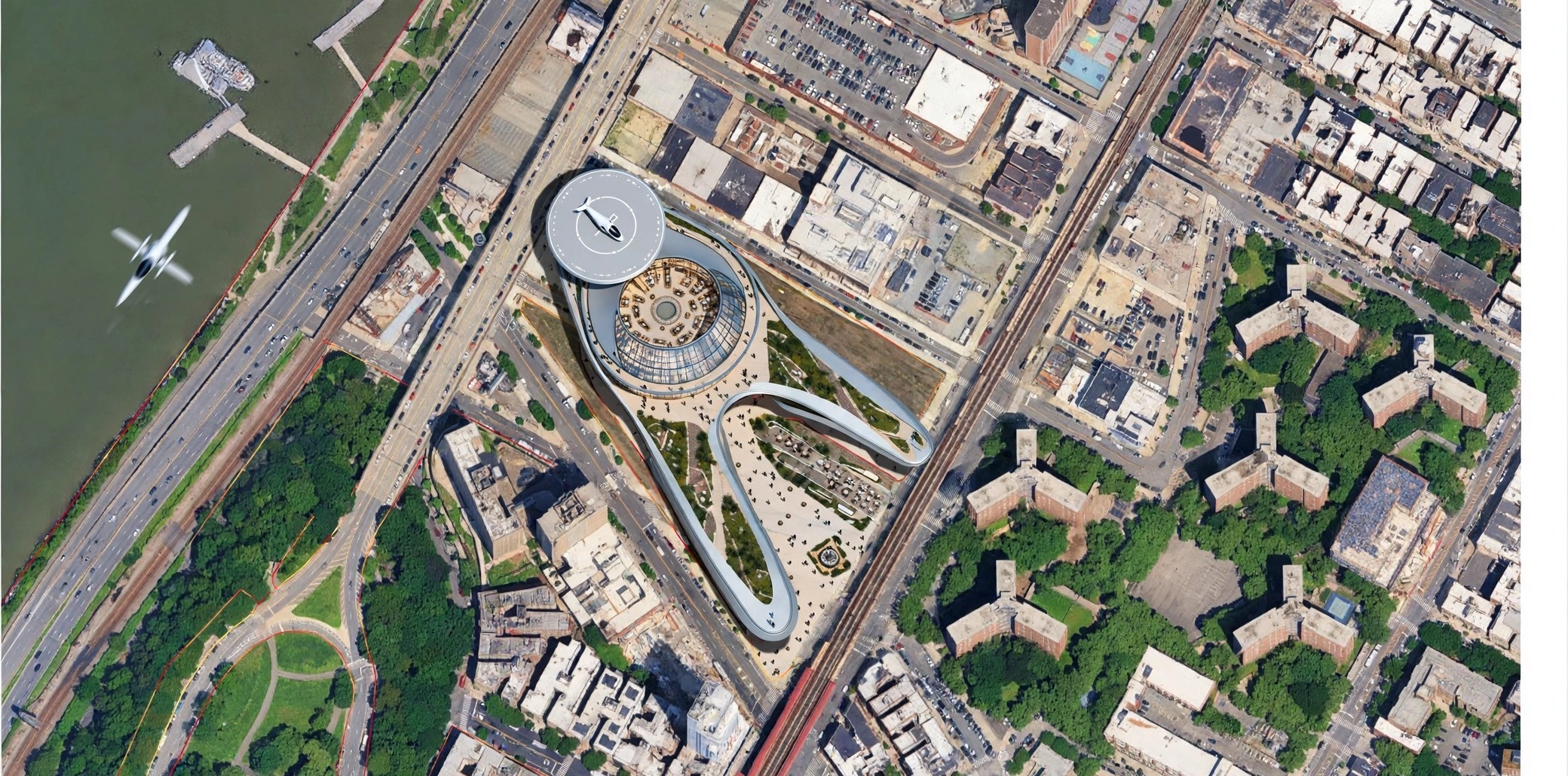
A vertiport on the Hudson River at 2328 12th Avenue in West Harlem — a landing pad above a public building with a restaurant ring, a grocery, training space, and a walkway connecting to the waterfront park.
Concept rendering of the Harlem Skyport, seen from above the Hudson River.
In active discussion with Columbia University, the landowner. The FAA has laid out the approval path, and aviation consulting firms are being selected now.
A vertiport at the entrance of Little Bay Park in Bayside, Queens — paired with a full fix-up of the park entrance the neighborhood has been asking for. The park stays public, and stays a park.
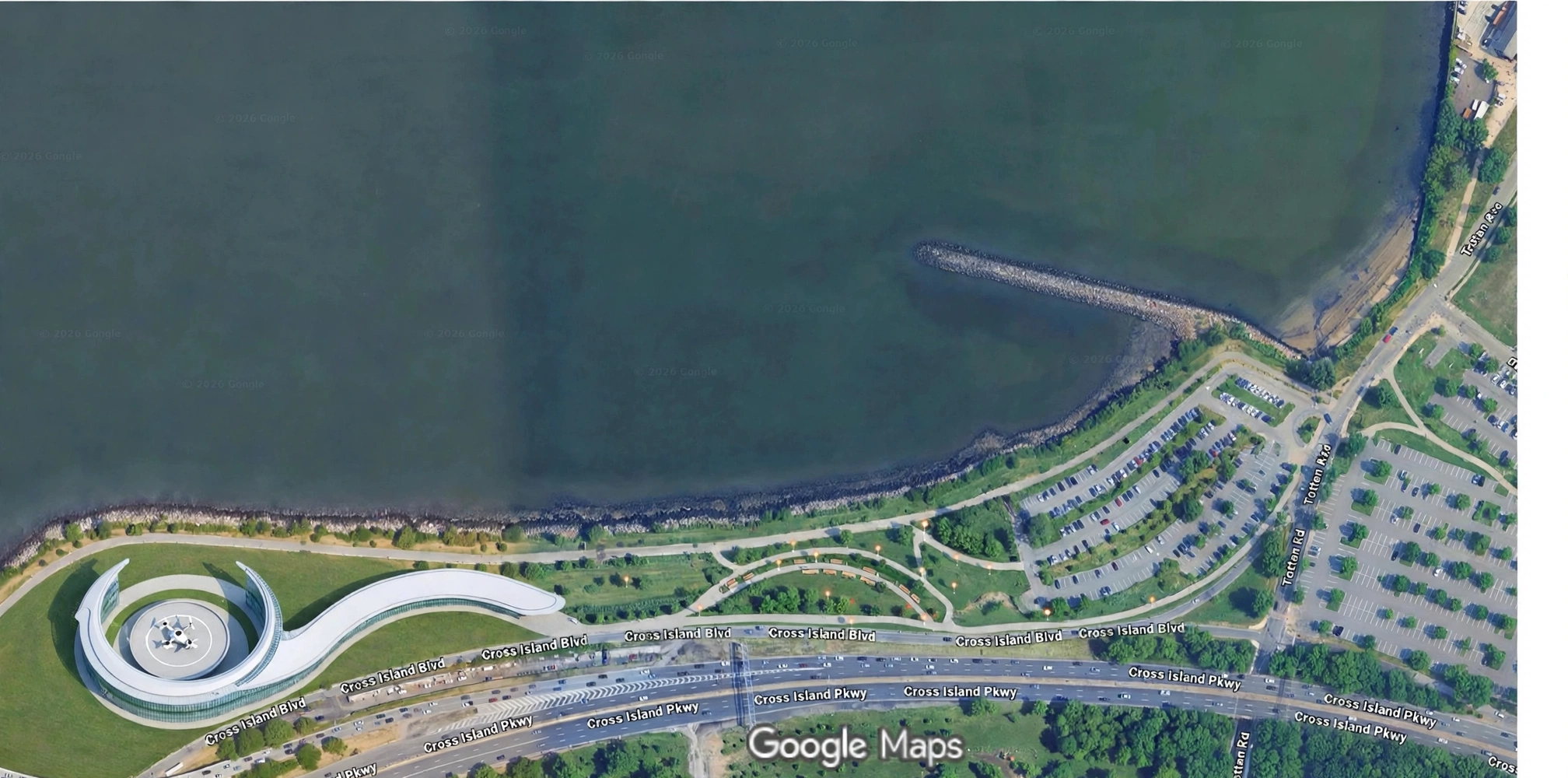
Concept view of the proposed building at the Little Bay Park entrance, with the landing pad set back from the water.
The full proposal is with the FAA and with the City Council. A community petition supporting the park improvements is live, and we are working with the Friends of Little Bay Park.
Read the one-page brief (PDF) — the same page delivered to the Council and the press.
Fixed paths, better lighting, benches, greenery, and real bathrooms for Little Bay Park — paid for privately, not by taxpayers. Add your name.
Sign the petitionThe same questions come up at every meeting and on every neighborhood page. Here are the honest answers.
No. These are electric aircraft, not helicopters. In NASA testing, the leading electric aircraft measured about 45 decibels in flight overhead — quieter than a normal conversation — and far below a helicopter. Flights come in and out over the water, and there are no night flights.
Private money. The Fort Totten project is estimated at roughly $67 to $117 million, funded privately — not by the city, and not by taxpayers. In return, the park gets the fix-up it has needed for years.
Yes. Little Bay Park stays a public park. The building sits at the park entrance, and the paths, lighting, benches, and bathrooms it pays for are for everybody.
Not yet — and we don't pretend otherwise. The FAA has laid out the approval path, the proposals are in front of the FAA, the Council, and the landowner, and each approval has to be earned in the open. This page tracks that process as it happens.
Nothing flies until the FAA says it can. Every site needs its own federal filing and review, engineered drawings, and city and state approvals before any construction — and the aircraft themselves are certified by the FAA before they can carry passengers.
This is a long road, measured in years, not months. Approvals come first. What we can promise is that every step happens in public — and this page will keep showing the record.
These projects move through real doors, in the open. Here is the record so far — who has been met with, who holds the proposals, and what has been filed and published.
Next steps, in the FAA's order: consulting-firm feasibility studies, zoning guidance from NYC Planning, coordination with the NYSDOT Aviation Bureau, and the two Form 7480-1 filings.
The aircraft these stations are built for are not drawings. They are flying today, with pilots and passengers, and they are in the final stretch of FAA certification. In 2024 the FAA created the "powered-lift" rules — the first brand-new category of aircraft since helicopters in the 1940s. Three American companies lead the field:
The S4 carries a pilot and four passengers at up to 200 mph. In November 2023 Joby flew the first electric air taxi flight in New York City, from the Downtown Manhattan Heliport. NASA measured it at 45.2 decibels in flight — quieter than a conversation. Joby is in the final stage of FAA certification, its first FAA-conforming aircraft began flight testing in March 2026, and Dubai's first vertiport station is already built.
BETA's ALIA family is an electric airplane (the CX300) and an eVTOL (the A250) on the same airframe. In June 2025 a CX300 carried four passengers from East Hampton into JFK — the first all-electric passenger flight into a major US airport — on about $7 of electricity, against roughly $160 of fuel for the same trip by helicopter. The US Air Force flies BETA aircraft, and since July 2026 BETA has been flying donated organs to transplant patients.
Archer's Midnight carries a pilot and four passengers. Archer holds an FAA air carrier certificate (Part 135), flew its first piloted flights in 2025, and in April 2026 became the first maker to finish Phase 3 of the FAA's four-phase certification process. With United Airlines, Archer has announced a New York network — Manhattan to JFK, LaGuardia, and Newark in 5 to 15 minutes — to start once certification lands. Archer is the official air taxi provider of the LA 2028 Olympics.
The honest picture: as of today, no electric air taxi holds its full FAA type certificate yet — the first ones are in the final stretch. That is exactly why the stations have to be planned now. When the aircraft are cleared to carry passengers, the cities with vertiports ready will be first.
While the air taxis finish certification, the flying car itself has stopped being a joke. The proof, all of it on the record:
Every one of these machines needs the same thing the big air taxis need: a legal, safe, approved place to land. That is what a vertiport is — and that is what we're building.
Space Racer Vertiports is the vertiport development work of Space Racer LLC, founded by Carlos Martins of Bayside, Queens.
Carlos Martins
CarlosMartins@HarlemSkyport.com
813-863-3428